The short answer
In the UK, block paving typically costs somewhere around £70 to £130 per square metre supplied and laid, though simple jobs in standard concrete blocks can come in lower and clay or natural stone setts push higher. That square-metre rate is not just the blocks: it bundles the excavation, sub-base, edge restraints, laying course, the blocks themselves, jointing sand and labour. Plain concrete block paving sits at the cheaper end; clay pavers and permeable blocks cost more per metre. The headline rate falls on larger areas because fixed costs spread further, and rises on small, awkward or heavily cut areas. Always check whether a quote is supply-only or supply-and-lay, because the two are easily confused.
The per-square-metre figure is the quickest way to compare driveway quotes, but it only makes sense once you know what is bundled inside it. The same number can describe a thin overlay or a properly excavated, load-bearing drive.
Block paving cost per m2 at a glance
- Typical supply-and-lay rangeAround £70–£130 per m2
- Lowest-priced optionStandard concrete blocks
- Premium optionsClay pavers, natural setts, permeable
- Biggest cost driversSub-base depth, cutting, access
- Rate falls onLarger, simpler areas
What the per-square-metre rate includes
A genuine supply-and-lay square-metre rate for a driveway should account for the full build-up beneath your feet, not just the visible blocks. A correctly constructed drive is a layered structure, and each layer carries cost:
- Excavation and disposal: digging out the existing surface and soil to the required depth, then carting the spoil away — often a skip or grab lorry charge.
- Sub-base: a compacted layer of crushed stone (commonly MOT Type 1) that carries the load. A driveway needs a deeper sub-base than a path because it bears vehicle weight.
- Edge restraints: haunched edging or kerbs that lock the blocks in so they cannot creep apart under traffic.
- Laying course: a screeded bed of sharp sand the blocks sit on.
- The blocks: concrete, clay or natural stone, plus a cutting allowance for borders and curves.
- Jointing and compaction: kiln-dried sand brushed into the joints and the surface vibrated to lock everything together.
If a quote looks unusually cheap per metre, it often signals a shallower sub-base or thinner blocks — fine for a patio, risky under cars.
How block type changes the price
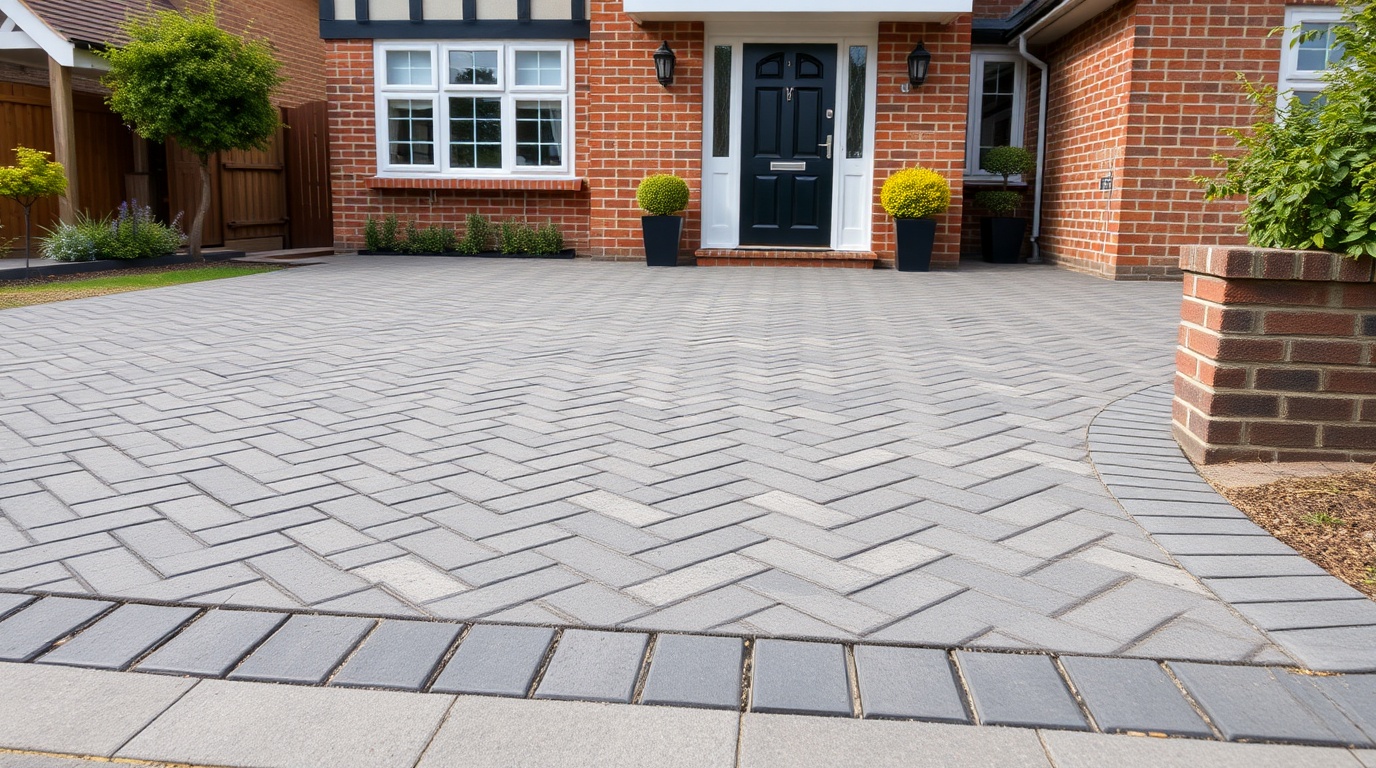
The single biggest material variable is what the blocks are made of. Concrete pavers are mass-produced and cheap; clay is fired and holds its colour for decades; natural setts are quarried stone. Permeable blocks have wider joints and a special sub-base so water drains through rather than running off.
The figures below are indicative supply-and-lay ranges for guidance — real quotes vary with region, access and design complexity.
It is worth remembering that the per-square-metre rate is an average across the whole job, not a fixed price for every metre. The first few metres carry a disproportionate share of the set-up, edge restraints and disposal, so a very small drive can sit above the quoted range, while a large, simple rectangle with good access tends to come in toward the lower end. Region matters too: labour rates in and around London and the South East typically run higher than in the North and the regions.
Design choices nudge the rate as well. A plain stretcher-bond layout in a single block colour is the most economical, while herringbone, contrasting borders, circles and changes of level all add cutting, waste and skilled time. None of this changes the area, yet it can move a quote by a meaningful amount, which is why two drives of identical size can be priced quite differently.
| Block type | Indicative cost per m2 (supplied and laid) | Notes |
|---|---|---|
| Standard concrete blocks | Around £70–£95 | Most common, widest colour choice |
| Clay pavers | Around £90–£130 | Long-lasting colour, harder wearing |
| Natural stone setts | Around £110–£160 | Premium look, more cutting and laying time |
| Permeable concrete blocks | Around £90–£130 | Wider joints, free-draining sub-base |
Indicative UK figures for guidance only; obtain itemised quotes for your site.
Why the rate rises or falls on your job
Two driveways of the same size can be priced very differently. The per-square-metre rate is sensitive to several practical factors:
- Area size: larger drives spread fixed costs — set-up, plant hire, edge restraints — over more metres, so the rate per metre usually drops. Small front gardens carry a higher rate because the fixed costs barely change.
- Cutting and pattern: herringbone borders, circles and curved edges mean more cuts and waste than a simple stretcher-bond rectangle, adding labour.
- Access: if a digger and lorries can reach the drive, groundworks are quick. Where spoil must be barrowed through a house or down a narrow passage, labour climbs.
- Ground condition: soft, wet or made-up ground may need a deeper sub-base or a geotextile membrane, increasing the build-up.
- Drainage and falls: a driveway must shed water, which may require a linear channel drain or a permeable build-up to satisfy planning rules on surface water.
Because of this, the most useful comparison is not the lowest headline rate but an itemised quote that states the excavation depth, sub-base type and block specification. That is what lets you tell a properly engineered drive from a cosmetic one.
Reading a per-square-metre quote properly
Once you have a few quotes in hand, the per-square-metre figure becomes a tool for comparison rather than a price in itself. The trick is to read each quote on substance, so that you are comparing genuinely similar builds. A handful of checks separates a well-specified drive from a cosmetic one:
- Excavation depth: a driveway is normally dug out far deeper than a patio because it carries vehicles. A quote that glosses over the dig depth, or assumes the existing ground can simply be paved over, is the commonest warning sign.
- Sub-base specification: look for a named material and a stated compacted thickness, typically crushed stone such as MOT Type 1. The sub-base is the engine of the drive; everything above it relies on it being right.
- Block thickness: driveway blocks are thicker than patio blocks for a reason. Thin blocks intended for foot traffic can crack and tilt under tyres.
- Edge restraints and haunching: the perimeter should be a properly haunched edging, not blocks butted against soil. Without it, the surface spreads.
- Jointing and compaction: kiln-dried sand brushed in and the surface vibrated locks the blocks together. A drive that skips proper compaction settles unevenly.
When two quotes differ sharply on price, the gap almost always lives in these lines, not in the visible blocks. A higher figure that specifies a deep, compacted sub-base, thick blocks and proper edge restraints is often better value than a cheaper one that leaves those details vague. The per-square-metre rate is most useful as a lens for spotting where a contractor has invested in the parts you will never see, because those are exactly the parts that decide whether the drive lasts a few years or a few decades.
Frequently asked questions
Is block paving cheaper per square metre on a bigger driveway?
Usually yes. Fixed costs such as plant hire, set-up and edge restraints are spread over more square metres on a larger drive, so the rate per metre tends to fall. A small front garden carries a higher rate because those fixed costs barely reduce on a tiny area.
Why is clay block paving more expensive than concrete?
Clay pavers are kiln-fired, which makes them harder wearing and means their colour runs right through and barely fades. Concrete blocks are cheaper to manufacture but their surface colour can soften over time. The price gap reflects durability and longevity rather than appearance alone.
Does the per-square-metre price include digging out and disposal?
A proper supply-and-lay rate should include excavation, removing the spoil, the sub-base and edgings, not just the blocks. Always confirm this, because some low quotes assume the area is already dug out or exclude waste disposal, which can add a significant cost.
Sources & further reading
Figures on this page are typical UK ranges drawn from published sources and depend on your specific site. They are guidance, not a quotation.