The short answer
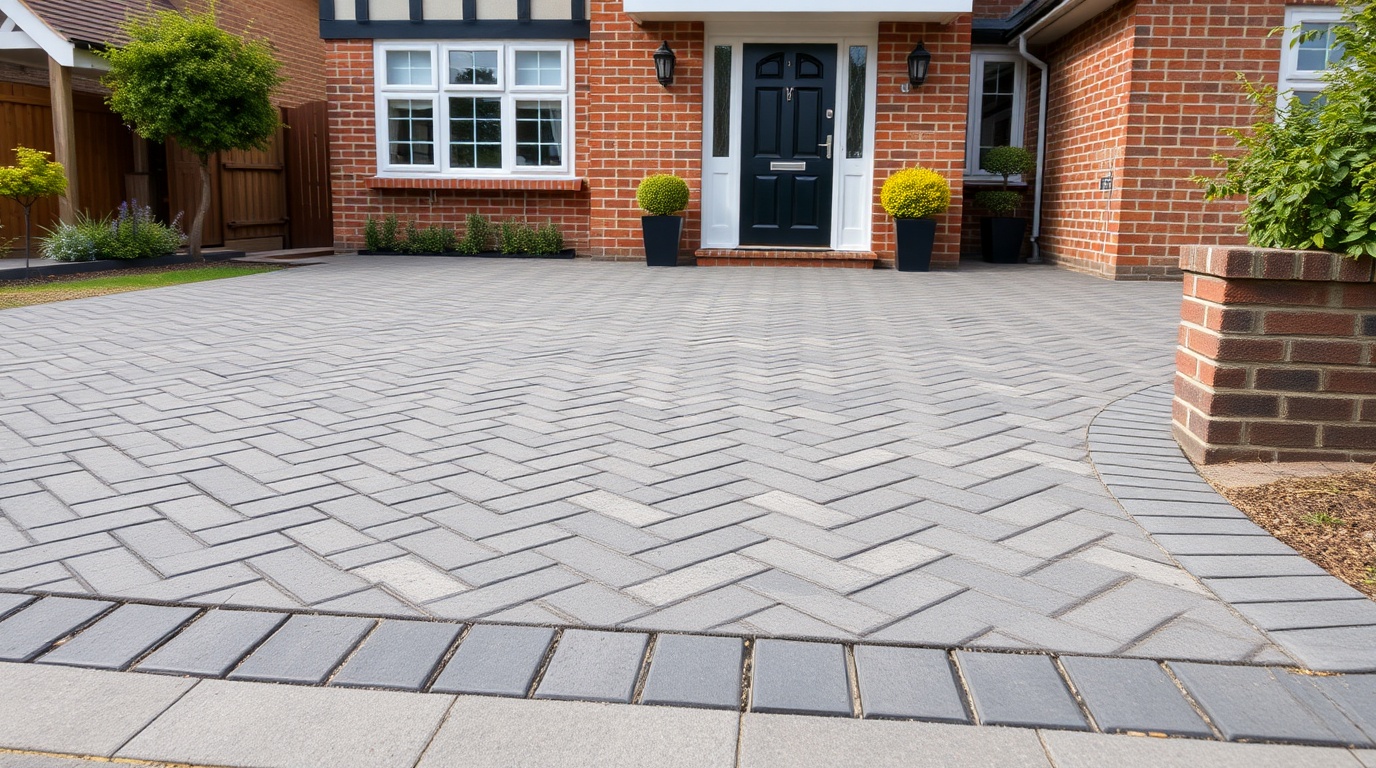
Block paving is laid as individual blocks over sand and a compacted sub-base, forming a flexible surface, while a concrete driveway is a single rigid slab poured and cured in place. The defining difference is how each handles ground movement. Concrete is hard-wearing and inexpensive over large areas, but as a rigid slab it can crack if the ground beneath shifts, and a crack is awkward to repair invisibly. Block paving flexes with minor movement and lets you lift and relay individual blocks to fix a sunken area or reach a buried service. Plain concrete is also harder to make permeable, whereas block paving can be specified as a permeable system. Concrete suits a plain, durable, lower-cost surface; block paving suits appearance, repairability and drainage.
Both are durable, long-established UK driveway surfaces, so the decision turns on cracking risk, repairability, drainage and the look you want. This page compares them directly.
Quick comparison
- Concrete structureSingle rigid slab
- Block paving structureFlexible jointed blocks
- Cracking riskHigher with concrete
- Spot repairsEasier with block paving
- Permeable optionBlock paving more readily
Rigid slab versus flexible blocks
The two surfaces behave quite differently because of how they are built.
- Concrete is poured as a continuous slab over a prepared sub-base, reinforced (often with mesh or fibres) and finished while wet. Once cured it is a single rigid plane. Movement joints are cut or formed to control where it cracks, but as a rigid material it cannot flex with the ground.
- Block paving is a flexible system: many separate blocks on sand over a compacted sub-base, held by edge restraints. Small ground movements are absorbed across the joints rather than concentrated into a single crack.
This is the core of the comparison. A concrete drive that experiences ground movement — from settlement, tree roots or frost heave — can crack across its surface, and once cracked it is difficult to repair without a visible patch or replacing a section. Block paving tends to move and settle more gracefully, and where it does dip, the affected blocks can be lifted and relaid on a corrected base.
Cost, durability and repairs
On cost, plain poured concrete is often economical, especially over large areas, because it is a single pour rather than labour-intensive hand-laying. Decorative concrete finishes (such as imprinted or stamped concrete) cost more and narrow the gap with block paving. Block paving is more labour-intensive, with cost rising for complex patterns and borders.
On durability, both are robust. A well-laid concrete slab on a sound sub-base carries heavy vehicle loads well and lasts many years. Block paving is also long-lived; crucially, its lifespan can be extended almost indefinitely because individual blocks can be swapped out as they wear or are damaged.
On repairs, block paving is clearly the more forgiving. A localised problem — a sunken patch, an oil-stained block, or a trench dug for a utility — can be fixed by lifting and relaying the relevant blocks. Concrete repairs are harder: cracks can be filled but rarely disappear, and replacing a section leaves a colour-and-texture mismatch with the surrounding slab.
| Factor | Block paving | Concrete |
|---|---|---|
| Structure | Flexible, jointed blocks | Rigid single slab |
| Cracking risk | Low (flexes, settles) | Higher (rigid slab) |
| Spot repairs | Lift and relay blocks | Hard to patch invisibly |
| Cost (plain) | Higher per m² | Often lower per m² |
| Design choice | Many colours and patterns | Plain, or pricier decorative finishes |
| Permeable option | Yes (permeable system) | Hard; needs special detailing |
Indicative comparison for guidance only.
Drainage, appearance and which suits your home
Drainage is a real differentiator under UK rules. A solid concrete slab is impermeable, so on a front driveway over five square metres draining to the road it can trigger planning permission unless drainage is directed to a permeable area on site. Making concrete itself permeable requires specialist no-fines or porous concrete and careful detailing, which is uncommon for domestic drives. Block paving, by contrast, can be readily specified as a permeable system with permeable jointing and a free-draining sub-base, which often keeps a front drive within permitted development.
Appearance favours block paving for variety: colours, shapes, laying patterns and contrasting borders. Plain concrete is utilitarian; decorative concrete (imprinted, brushed or coloured) widens the look but at extra cost, and patterns are printed rather than built from real units.
Which suits your home? Choose concrete for a plain, durable, cost-effective surface over a large area where appearance and permeability are lower priorities. Choose block paving where you want kerb appeal, easy individual repairs, and a build that can satisfy front-drive drainage rules without extra works. Many homeowners weigh concrete's lower upfront cost against block paving's repairability and drainage flexibility.
Installation, ground movement and what makes each last
The way each surface is built explains why one cracks and the other flexes, and understanding it helps you judge a quote and avoid early failure.
A concrete driveway relies on a rigid slab carrying loads across its whole area, so it must be thick enough and reinforced to resist bending. Movement joints are deliberately cut or formed at intervals to control where the slab cracks as it shrinks during curing and expands and contracts with temperature. If those joints are missed or badly spaced, the slab cracks randomly. The slab also needs a sound, well-compacted sub-base; if the ground beneath settles unevenly — from soft spots, tree roots, made-up ground or frost heave — the rigid slab has nowhere to go but crack. Concrete is therefore demanding to get right: correct thickness, reinforcement, joint layout, a good base and proper curing all matter.
Block paving spreads loads differently. Each block transfers load to its neighbours through the sand-filled joints, so the surface behaves as a flexible composite that can absorb minor ground movement without a single catastrophic crack. The price of that flexibility is the need for firm edge restraints bedded in concrete; without them, the blocks migrate outwards under traffic and the surface spreads and dips. As with concrete, the sub-base must be properly compacted and the falls set so water drains away.
The practical implication for the comparison is this: on stable, well-prepared ground, both surfaces last for decades. On ground prone to movement, block paving's flexibility and easy repairability give it an edge, because settlement shows as a liftable, relayable dip rather than a fixed crack. When comparing quotes, look closely at the sub-base depth, and for concrete at the slab thickness, reinforcement and joint plan, and for block paving at the edge-restraint detail — these hidden specifics decide which surface serves you well over time.
It is also worth remembering that the choice is not purely technical. A plain concrete drive reads as utilitarian, which may suit a working yard or a large area where appearance matters little, whereas block paving's patterns, borders and colours lend kerb appeal to the front of a house. Set against that, concrete's single-pour simplicity can be quicker on a big, regular shape. Weighing the cracking and drainage trade-offs alongside how the finished drive needs to look usually points clearly to one surface for a given home.
Frequently asked questions
Does a concrete driveway crack more than block paving?
It can. Concrete is a rigid slab, so ground movement, tree roots or frost heave can crack it, and cracks are hard to repair invisibly. Block paving is flexible and absorbs minor movement across its joints, and damaged blocks can simply be lifted and relaid.
Is concrete cheaper than block paving?
Plain poured concrete is often cheaper per square metre, especially over large areas, because it is a single pour rather than hand-laid. Decorative concrete finishes cost more and narrow the gap. Block paving's higher cost buys design choice, easier repairs and a permeable option.
Can a concrete driveway be permeable?
Plain concrete is impermeable. Permeable concrete (no-fines or porous mixes) exists but is uncommon for domestic drives and needs careful detailing. Block paving is more readily made permeable with permeable jointing and a free-draining sub-base, which can avoid planning permission on a front drive.
Sources & further reading
- Marshalls — Driveway paving guidance
- HomeOwners Alliance — Driveway ideas and costs
- Planning Portal — Paving your front garden
Figures on this page are typical UK ranges drawn from published sources and depend on your specific site. They are guidance, not a quotation.