The short answer
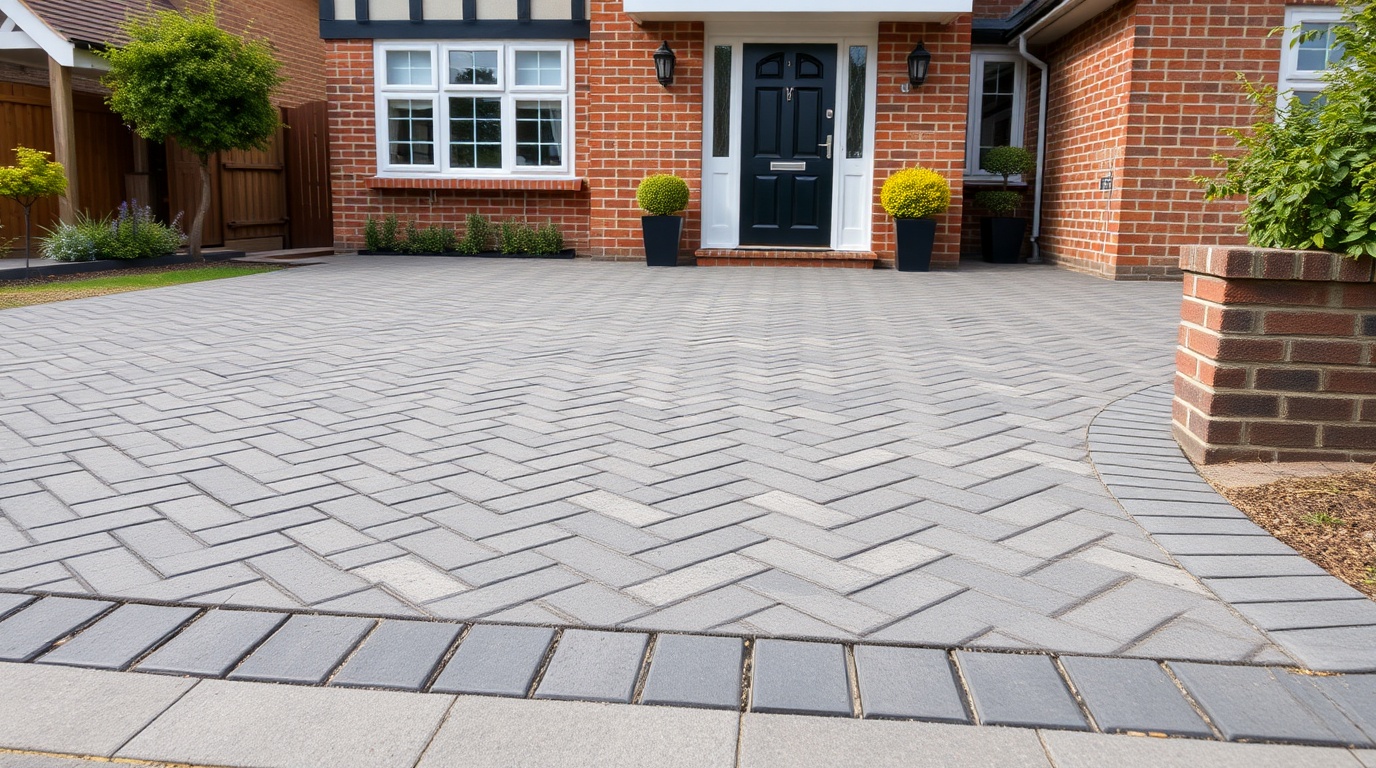
Block paving a typical UK driveway usually costs somewhere in the region of £3,000 to £8,000, with most single and double drives landing between those figures depending on size, block type and groundworks. As a rough guide, a small single drive of around 20–25 m² often falls near the lower end, while a generous double drive of 40–50 m² sits toward the upper end, and large or premium projects can exceed it. The total covers excavation, sub-base, edgings, blocks, laying and jointing, plus any drainage needed to meet surface-water rules. Clay or natural setts, difficult access, deep sub-bases on soft ground, and channel drains all push the figure up. The per-metre rate drops on larger areas, so cost does not scale in a straight line with size.
Most homeowners want a whole-job number, not a per-metre rate. That figure depends heavily on driveway size, but also on what lies beneath the surface and how easily machinery can reach the site.
Cost to block pave a driveway
- Typical overall rangeAround £3,000–£8,000
- Small single drive (≈20–25 m²)Lower end of the range
- Double drive (≈40–50 m²)Mid to upper end
- Adds costDrainage, deep sub-base, poor access
- Time on siteOften around 1–2 weeks
Cost by driveway size
Driveway size is the headline driver of total cost, but the relationship is not linear — the rate per square metre tends to fall as the area grows, because fixed costs such as set-up, plant hire and edge restraints spread further. The ranges below are indicative supply-and-lay totals for guidance only.
Two further things commonly catch people out on a driveway total. The first is the dropped kerb: if the existing footway crossing is too narrow or absent, a vehicle crossover has to be applied for and built, which is a separate cost paid to the council and its approved contractor, not the paver. The second is drainage: a driveway over five square metres must either drain to a permeable surface or direct water to a soakaway or border rather than to the public sewer, and meeting that rule can add a channel drain or a permeable build-up to the quote.
It also pays to confirm what edging the quote assumes, since a driveway needs a robust, haunched edge restraint to stop the blocks creeping under the weight of vehicles. A drive edged only with a token kerb, or laid without a proper edge course, will tend to spread and rut at the margins within a few years, so the edging is part of the structure rather than a finishing extra.
| Driveway size | Approx area | Indicative total (supplied and laid) |
|---|---|---|
| Small single | Around 15–25 m² | Around £2,000–£3,500 |
| Standard single | Around 25–35 m² | Around £3,000–£5,000 |
| Double | Around 40–50 m² | Around £4,500–£8,000 |
| Large / premium | 60 m²+ | £8,000+ |
Indicative UK figures for guidance only; figures rise with premium blocks, drainage and difficult ground.
What you are actually paying for
A finished block-paved driveway is a layered, load-bearing structure, and the cost reflects each stage of building it properly:
- Excavation and disposal: digging out to the required depth and removing the spoil. On a driveway this is deeper than a patio because it must carry vehicles.
- Sub-base: a compacted layer of crushed stone (typically MOT Type 1) that spreads vehicle load. Soft or wet ground needs a deeper sub-base, sometimes with a geotextile membrane.
- Edge restraints: haunched edgings or kerbs that hold the perimeter so blocks cannot spread.
- Laying course and blocks: a screeded sharp-sand bed, then the blocks laid to pattern with a cutting allowance for borders and curves.
- Jointing and compaction: kiln-dried sand brushed in and the surface vibrated to lock it together.
- Drainage: the drive must shed surface water. Depending on the design and planning rules, this may mean falls to a border, a linear channel drain, or a fully permeable build-up.
The groundworks and labour usually make up the larger share of the total — the blocks themselves are only one line on the bill.
What pushes the figure up or down
Beyond size, several practical factors swing the total significantly:
- Block choice: standard concrete is the lowest-priced; clay pavers and natural setts cost noticeably more per metre and add up across a whole drive.
- Access: if a digger and lorries can reach the drive directly, groundworks are quick and cheap. Where spoil must be barrowed through the property, labour climbs.
- Ground condition: tree roots, old foundations, soft clay or a high water table can all force a deeper or reinforced build-up.
- Drainage requirements: meeting surface-water rules with channel drains or a permeable system adds material and labour.
- Design complexity: circles, curves, contrasting borders and intricate patterns mean more cutting, more waste and more time.
- Removing the old surface: breaking out an existing concrete or tarmac drive adds to the excavation cost.
Because of these variables, the most reliable way to budget is to get two or three itemised quotes that state the excavation depth, sub-base specification, block type and drainage approach. A quote that is much cheaper than the rest usually cuts a corner that shows up as sinking or ponding within a few years.
Budgeting beyond the headline figure
A driveway quote is rarely just one number, and the households who avoid surprises are the ones who budget for the whole project rather than the paving alone. Several costs sit alongside the laying itself and are worth planning for from the start:
- Dropped kerb: if you are creating new off-street parking, you may need to lower the kerb across the public footway. This is usually a council-controlled job priced separately from the drive, and it requires permission because it crosses the highway.
- Drainage to meet the rules: a front driveway larger than 5 m² that does not drain to a permeable area can need planning permission. Permeable paving or a channel drain to a soakaway keeps you within permitted development but adds to the cost.
- Removing the old surface: breaking out an existing concrete or tarmac drive, and disposing of the spoil, is an extra stage on top of the new build.
- Reinstating boundaries: moving a gate, adjusting a wall or repositioning a manhole cover to sit flush can add small but real costs.
- Contingency: because ground conditions are invisible until the surface is lifted, a buffer of around 10–15% protects against soft ground or old foundations needing a deeper build-up.
Thinking about these elements before you commit turns a rough estimate into a dependable budget. The biggest avoidable shock is discovering, mid-project, that the ground needs a deeper sub-base or that a dropped kerb and drainage are required to satisfy the rules. A contractor who walks the site, checks the ground and explains the drainage approach upfront is giving you a more honest figure than one who simply multiplies area by a flat rate.
Frequently asked questions
How long does it take to block pave a driveway?
Most single and double drives take roughly one to two weeks, depending on size, access and weather. The schedule covers excavation and spoil removal, laying and compacting the sub-base, installing edgings, laying the blocks and jointing. Drainage works or difficult ground can extend it.
Do I need planning permission to block pave my front garden?
If the new surface is more than 5 m² and does not allow water to drain naturally — for example to a permeable area or soakaway within the property — planning permission may be required. Using permeable paving or directing run-off to a border usually keeps the work within permitted development.
Is block paving cheaper than resin or tarmac for a driveway?
It varies. Tarmac is often the lowest-priced large-area surface, while block paving and resin-bound cost more but offer different looks and repairability. Block paving's advantage is that individual blocks can be lifted and reset, which makes repairs after a trench or settlement straightforward compared with a continuous surface.
Sources & further reading
- Checkatrade — Block paving driveway cost
- HomeOwners Alliance — Driveways
- gov.uk — Planning permission for paving front gardens
Figures on this page are typical UK ranges drawn from published sources and depend on your specific site. They are guidance, not a quotation.